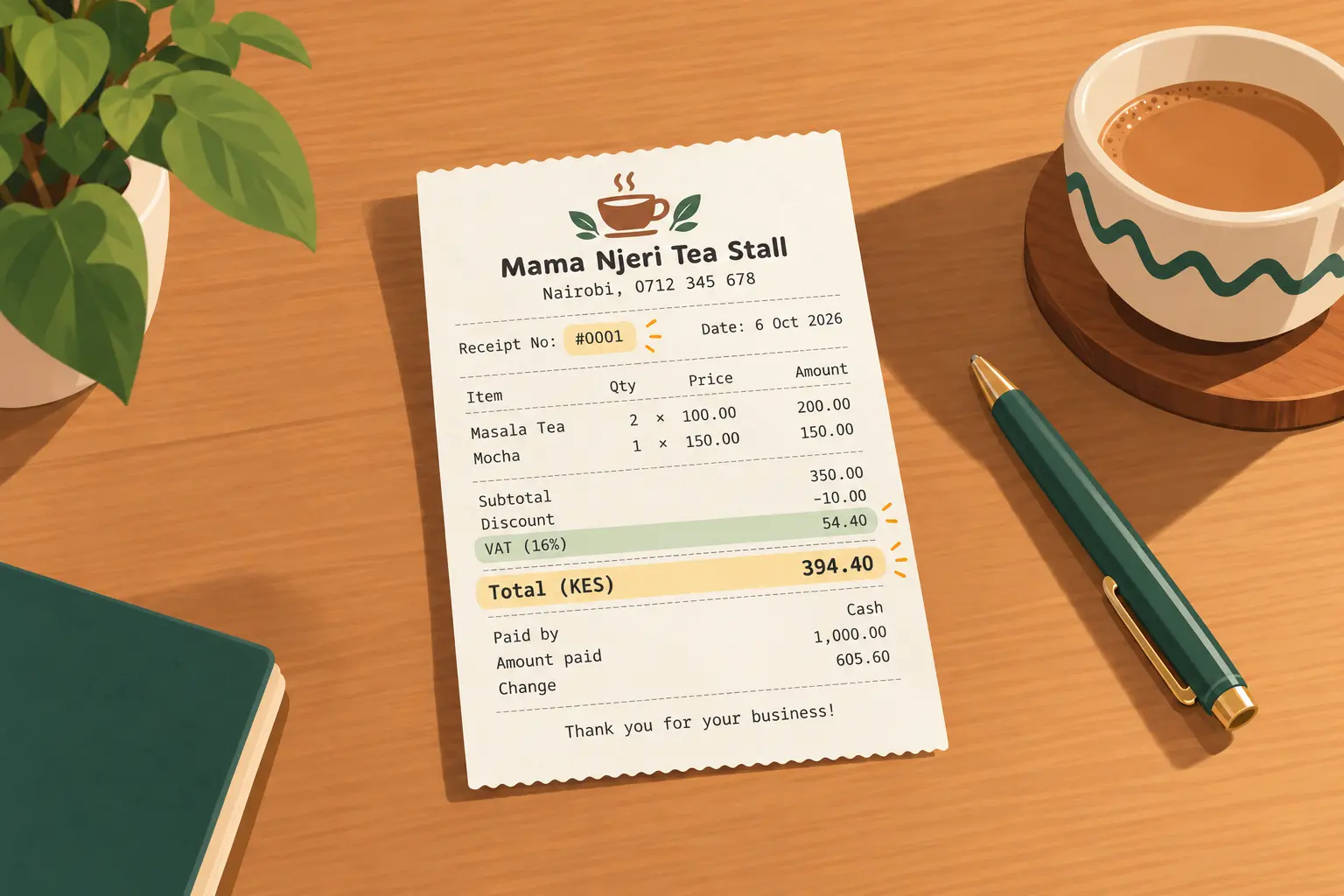
Almost nobody keeps a receipt until the day they need one. Then it matters a great deal: a customer wants to return something, an accountant asks where an expense came from, or two people remember a payment differently.
A good receipt is a small thing that does a lot of quiet work. This is a checklist of what one should include, and what tends to go wrong when it's left out.
Why bother giving a receipt at all?
For the customer, a receipt is proof. It's how they return a faulty item, claim a warranty or show their employer what they spent. A shop that gives clear receipts is easier to trust.
For you, it's a record. Receipts let you check the till against your sales, settle a disagreement about what was bought, and see your own business more clearly. And in some places, giving receipts isn't optional. In Kenya, for instance, all registered businesses must issue eTIMS-registered receipts. Rules differ from country to country, but most require VAT-registered businesses to issue receipts in a particular way, so check with your local tax authority.
The checklist
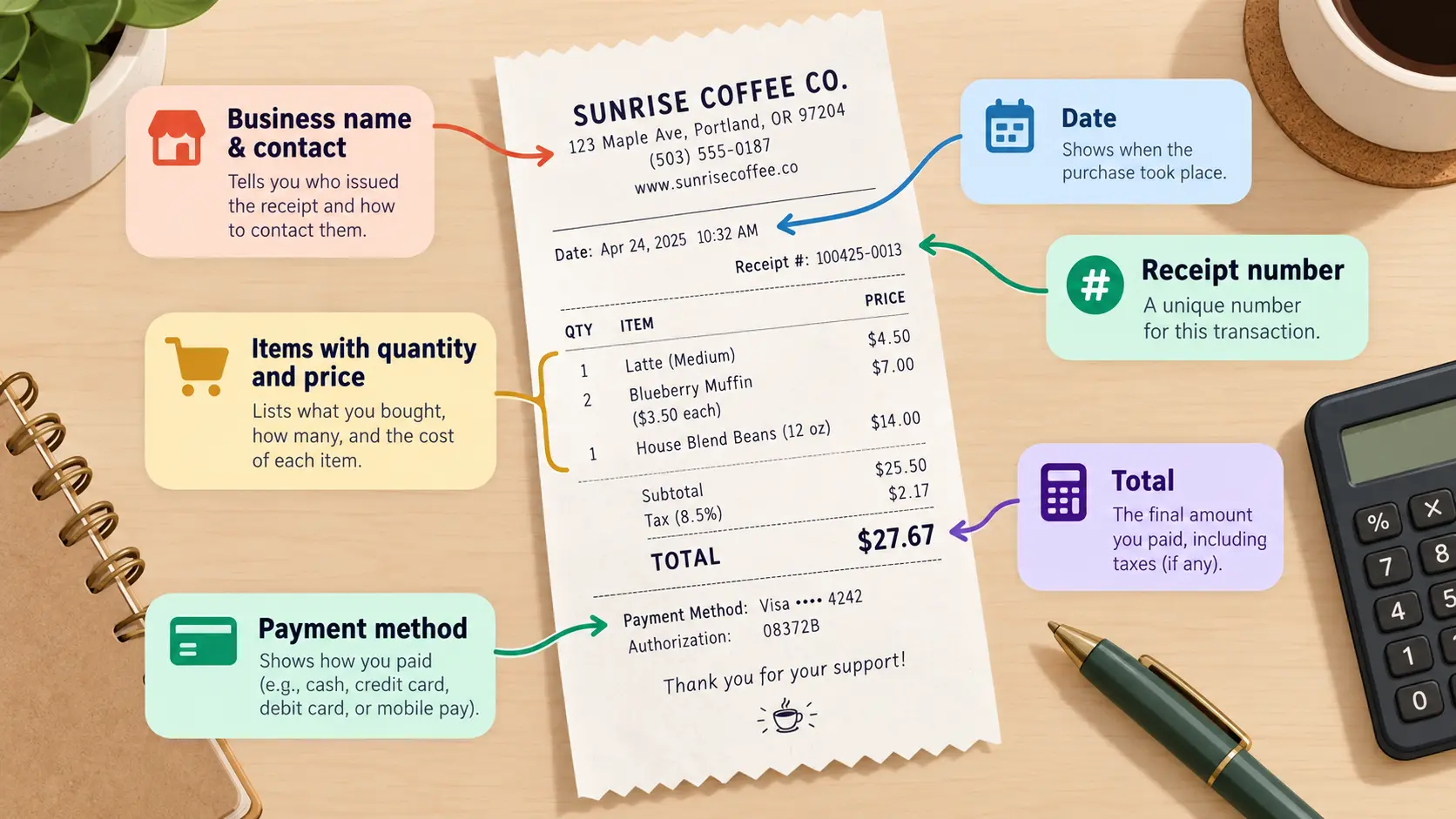
- Your business name, and a phone number or address so the customer can reach you.
- The date of the sale.
- A receipt number that is different on every receipt.
- What was bought, with the quantity and price of each item.
- The total the customer paid.
- How they paid: cash, mobile money, card or bank transfer.
Those six are the core. If a receipt has them, it's useful. Anything else is a bonus.
Useful extras
Depending on your business, a few more lines make a receipt better.
- Any VAT or sales tax, shown separately. If you charge it, it should be visible as its own line.
- Any discount. Show it as a line, so the numbers add up.
- The amount paid and the change given. It settles the "I gave you a bigger note" argument before it starts.
- The customer's name. Mostly for business customers, who often need it for their own records.
- Your tax registration number, if you have one.
- A short note, such as your returns policy or a thank-you.
A receipt, line by line
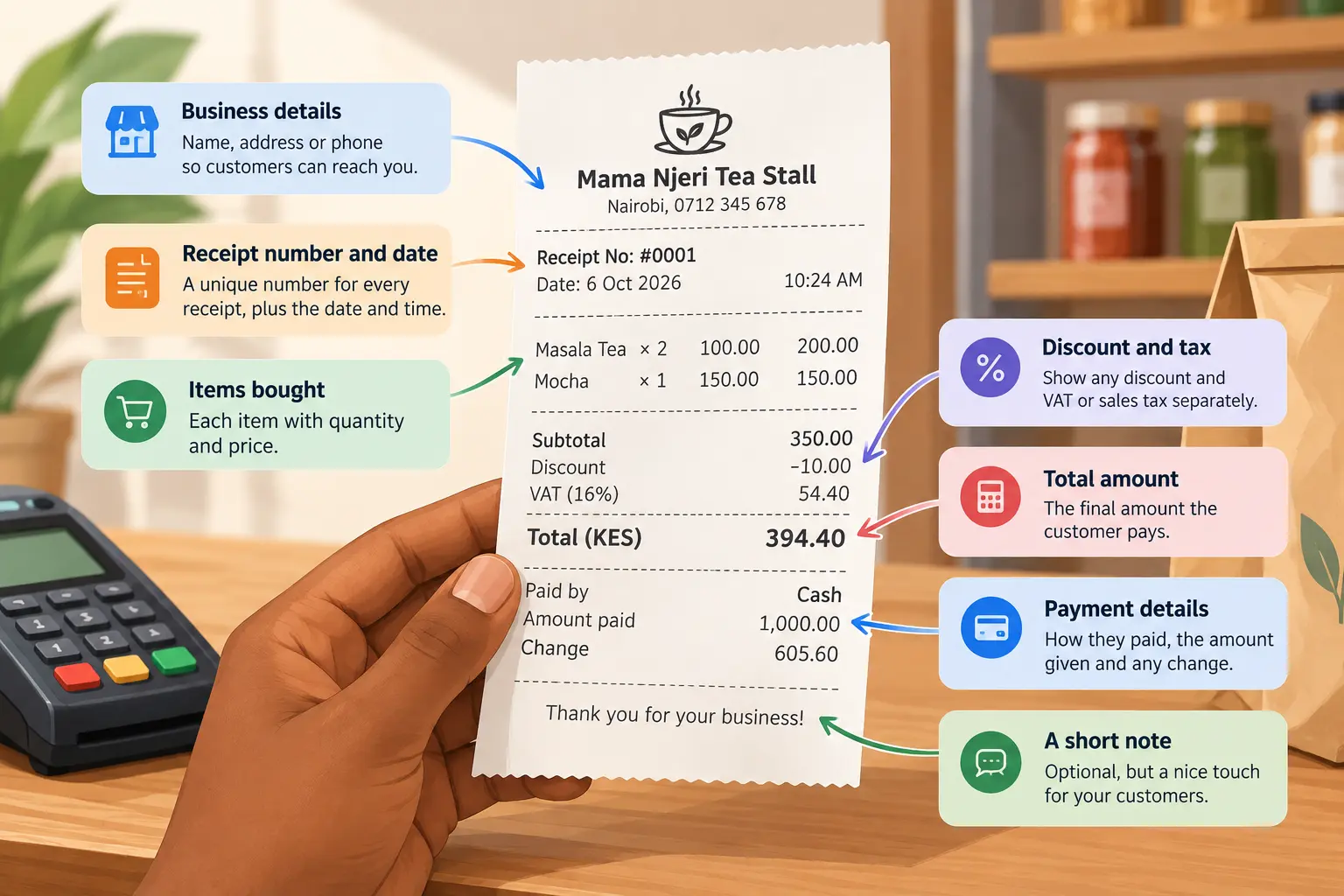
Here is a small sale, laid out the way a receipt reads. The prices are shown before VAT, so the tax is added on top. You can reproduce it in our receipt generator in about a minute.
| On the receipt | Example |
|---|---|
| Business | Mama Njeri Tea Stall |
| Contact | Nairobi, 0712 345 678 |
| Receipt number and date | #0001, 6 Oct 2026 |
| Masala Tea | 2 × 100.00 = 200.00 |
| Mocha | 1 × 150.00 = 150.00 |
| Subtotal | 350.00 |
| Discount | −10.00 |
| VAT (16%) | 54.40 |
| Total (KES) | 394.40 |
| Paid by | Cash |
| Amount paid | 1,000.00 |
| Change | 605.60 |
| Note | Thank you for your business! |
Read it down, and every number can be checked. Two cups of masala tea at 100 and one mocha at 150 make 350. Take off the 10 discount and you have 340, and 16% of that is 54.40. Add it up and the total is 394.40. Pay with 1,000, and the change is 605.60. There are no leaps, and anyone can follow it.
Notice that for the sake of this example, the prices and change include cents. In practical cases, prices are usually rounded unless the currency can be issued in cents.
The details people forget
Receipt numbers that don't repeat
It's tempting to skip the number, and it's the part that makes a receipt trustworthy. Numbers that run in order (0001, 0002, 0003) mean every sale has its own record, and a gap or a repeat tells you something has gone wrong. If two customers both hold a receipt numbered 0007, you have a problem.
Tax shown separately
If you charge VAT, don't hide it inside a single price. A product that sells for KES 1,160 including 16% VAT is KES 1,000 plus KES 160 in VAT. Showing both lines helps your customer if they can reclaim it, and it helps you keep the tax apart from your own income. The tax isn't yours, and the receipt is where that becomes visible.
Totals that add up
It sounds obvious, but a receipt where the lines don't add to the total causes more arguments than almost anything else. Show quantities, prices and discounts as separate lines, and let the sum speak for itself.
Receipt, invoice, or something else?
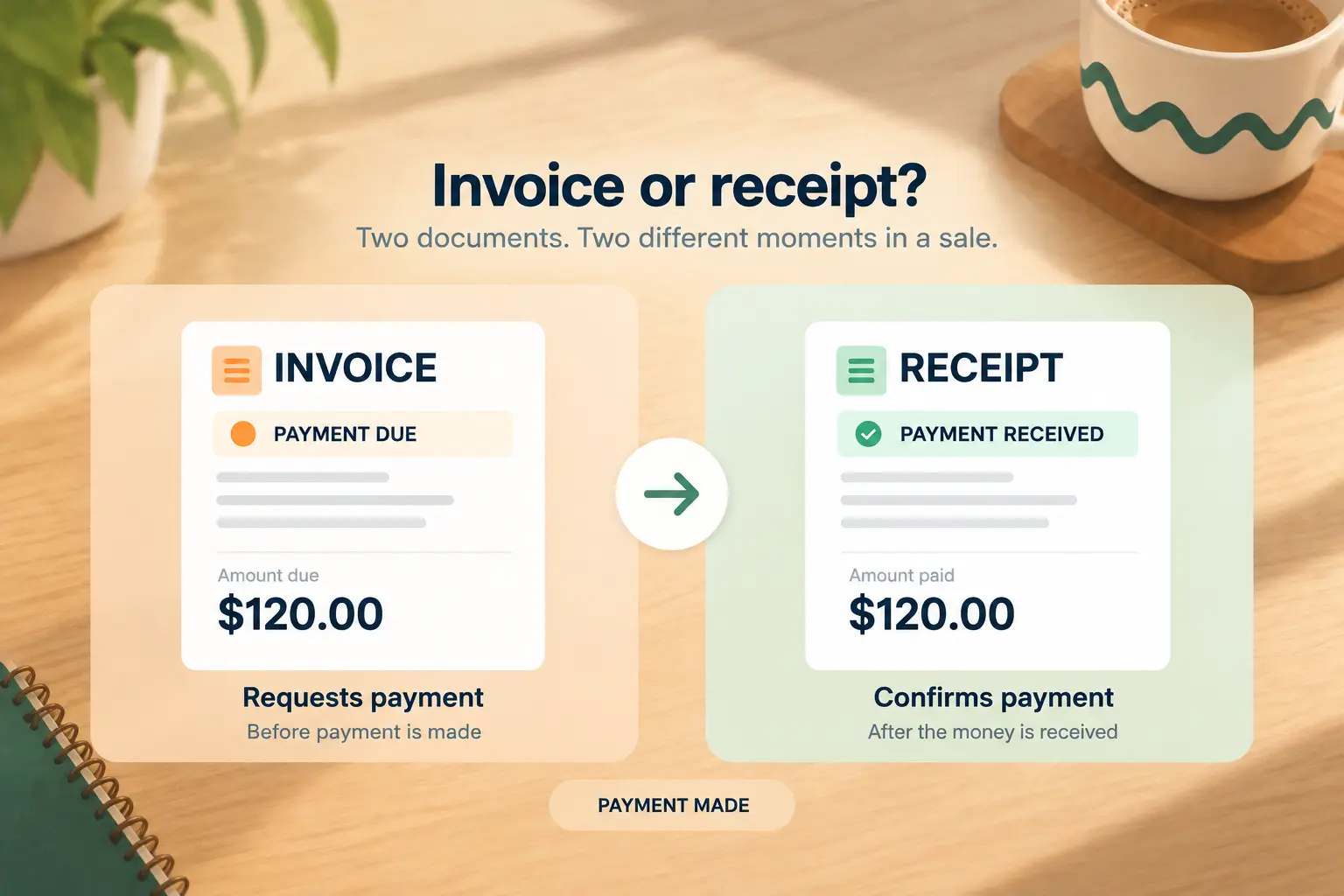
A receipt confirms that money has already been paid. An invoice asks for payment and is sent before or when the payment is due. If a customer pays later, send an invoice first, and a receipt when they pay. Using the right word on the right document avoids confusion, particularly with business customers who file them separately.
Mistakes worth avoiding
Handwritten receipts nobody can read. If you write them by hand, write clearly, and press hard enough for a copy to show through. A receipt the customer can't read isn't worth much.
Not keeping a copy. Your own records matter as much as theirs. Keep a copy of every receipt you issue, whether that's a carbon copy, a photo or a saved file.
Giving receipts only when asked. The one you didn't give is always the one that causes the trouble. Making it automatic is easier than judging each sale.
Reusing numbers. If you start a new book or a new file, carry on from where you stopped.
Paper, PDF or both?
The paper size depends on what you print on. Narrow rolls of 58mm and 80mm are standard for till printers, and A4 suits an office printer. If you'd rather not print at all, a PDF can be sent straight to a customer's phone, and it makes a tidy record for you too.
Our free receipt generator makes any of them. Fill in your business details and items, watch the receipt update, and download a PDF to print or share. Everything stays in your browser, and nothing you type is uploaded.
How long to keep them
Keep a copy of every receipt you issue, in a folder by month, whether that's paper or files. How long you must keep records depends on your country and the kind of business you run. Ask your tax authority or an accountant, and when in doubt, keep them longer.
Final thoughts
A receipt is a small courtesy that protects both you and your customer. It doesn't need to be fancy. It needs the six things on the checklist, honest totals, and a number that never repeats.
If you currently give receipts only when someone asks, try giving one every time for a week. It may feel like extra work for a day or two. After that, it's just part of selling, and the first time it settles a disagreement in seconds, you'll be glad you did.
If you also want to stay on top of what you're selling, keeping a stock record is the natural partner to good receipts.
Key takeaways
- Every receipt needs six things: your business name, the date, a receipt number, the items, the total and how it was paid.
- Show VAT and discounts as separate lines, and make sure the totals add up.
- Receipt numbers should run in order and never repeat.
- A receipt confirms payment. An invoice asks for it.
- Keep a copy of every receipt you issue, and check your local rules for how long.